Allstream Insiders Summary
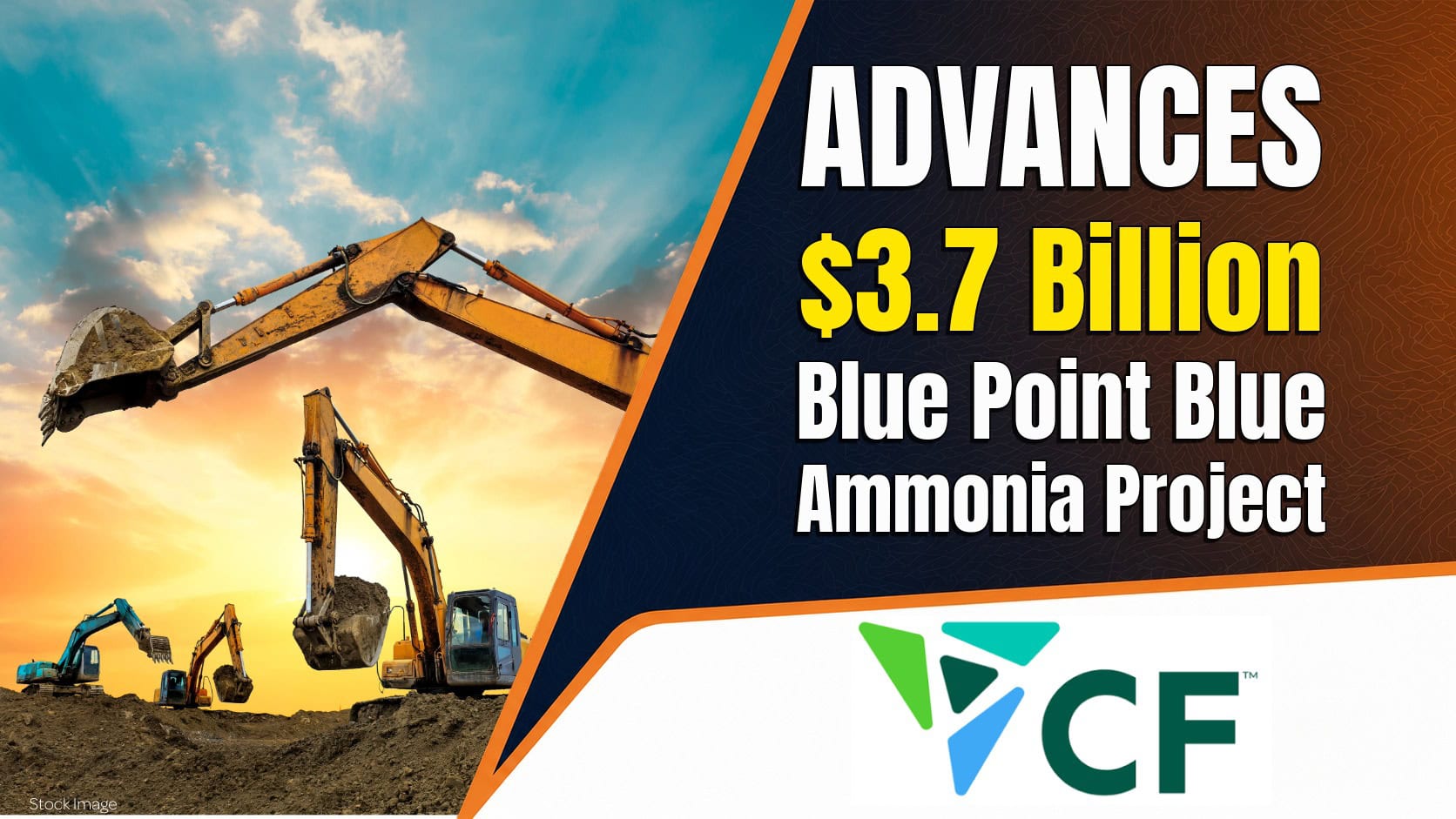
CF Industries is advancing its approximately $3.7 billion Blue Point low-carbon ammonia project in Modeste, Louisiana. The company reported that state and federal permits received in July 2026 enabled construction at the Blue Point Complex to commence in August. Low-carbon ammonia production remains targeted for 2029.
The greenfield facility is being developed through Blue Point Number One, a joint venture owned 40% by CF Industries, 35% by JERA and 25% by Mitsui. It is designed for approximately 1.4 million metric tons of annual ammonia production and is expected to capture more than 95% of the carbon dioxide generated by the ammonia-production process.
CF Industries reported $143 million of joint-venture project capital expenditures during the first six months of 2026 and $450 million of project capital expenditures through June 30, 2026. The joint venture continues to plan approximately $600 million of project spending in 2026. CF Industries separately plans approximately $550 million of wholly owned common infrastructure at Blue Point, including product storage and vessel-loading facilities, with approximately $150 million planned for that scope during 2026.
The company also disclosed a pending federal lawsuit seeking to suspend the final permits. According to CF Industries’ August 6 Form 10-Q, the company and the U.S. Army Corps of Engineers filed motions in opposition to the plaintiffs’ preliminary-injunction request. CF Industries said the matter was ongoing and that it could not predict the outcome.
Blue Point Project Tracker
| Project element | Company-reported scope | Capital or capacity | Status and schedule |
|---|---|---|---|
| Blue Point low-carbon ammonia facility | Greenfield autothermal-reforming ammonia plant with carbon-dioxide dehydration and compression | Approximately $3.7 billion; approximately 1.4 million metric tons per year | CF Industries reported that state and federal permits received in July 2026 enabled construction to commence in August 2026; production targeted for 2029 |
| Blue Point common facilities | Product storage, vessel loading and other scalable site services | Approximately $550 million, funded and owned by CF Industries; $150 million planned in 2026 | Planned on a schedule similar to the ammonia facility |
| Linde air-separation unit | On-site oxygen and nitrogen supply for the ammonia process | Linde plans to invest more than $400 million in a separately owned facility | Linde will design, build, own and operate the unit; startup targeted for 2029 |
| Carbon transportation and sequestration | Pipeline transportation and permanent geologic storage through the 50/50 Enbridge-1PointFive Pelican Sequestration Hub joint venture | Approximately 2.3 million metric tons of carbon dioxide per year under a 25-year agreement | Enbridge is expected to develop, construct and operate the pipeline; 1PointFive is expected to develop and operate the sequestration facilities |
What Is the Blue Point Blue Ammonia Project?
Blue Point is a planned world-scale ammonia complex that will use autothermal reforming and carbon capture and sequestration to reduce the carbon intensity of ammonia made from natural gas. CF Industries generally describes the product as low-carbon ammonia. “Blue ammonia” is a commonly used industry description for ammonia produced from fossil fuels where a substantial portion of production-related carbon dioxide is captured and stored; the term does not, by itself, establish a standardized lifecycle-carbon threshold.
The production facility will include a carbon-dioxide dehydration and compression unit. The project is designed to capture, compress and dehydrate approximately 2.3 million metric tons of carbon dioxide annually, representing more than 95% of the carbon dioxide generated during ammonia production.
The Pelican Sequestration Hub is being developed through a 50/50 joint venture between Occidental subsidiary 1PointFive and Enbridge. Under the companies’ disclosed arrangement, Enbridge is expected to develop, construct and operate the transportation pipeline, while 1PointFive is expected to develop and operate the facilities required to permanently store the carbon dioxide. The 25-year agreement covers approximately 2.3 million metric tons per year.
CF Industries has stated that the ammonia production facility is expected to qualify for federal Section 45Q tax credits tied to carbon dioxide captured and placed in secure geological storage. Actual eligibility will depend on satisfaction of the applicable statutory and regulatory requirements.
The project should not be described as zero-carbon ammonia. Its disclosed emissions-reduction scope is based on capturing carbon dioxide generated by the production process, and CF Industries uses the more qualified “low-carbon” description in its filings.
How Much Is CF Industries Investing at Blue Point?
CF Industries’ latest estimate places the joint venture’s low-carbon ammonia production facility and carbon-capture scope at approximately $3.7 billion. CF Industries, JERA and Mitsui fund the facility’s engineering, procurement and construction according to their respective 40%, 35% and 25% ownership interests.
The joint venture recorded $65 million of capital expenditures in the first quarter of 2026 and $78 million in the second quarter, bringing first-half spending to $143 million. Project-to-date capital expenditures reached $450 million as of June 30.
The current 2026 plan includes approximately $600 million of joint-venture capital expenditures for the ammonia facility. CF Industries’ 40% share of that annual plan is approximately $240 million, while JERA and Mitsui would fund the remaining approximately $360 million through their combined ownership interests.
CF Industries is also planning a separate $550 million investment in common facilities that it will own and operate. That scope includes product storage and vessel loading, with approximately $150 million planned during 2026. The company reported $59 million of spending on the common facilities during the first half of the year.
Linde’s planned investment of more than $400 million covers an air-separation unit that Linde will own and operate. Because the Linde facility and CF Industries’ common facilities have different owners and commercial structures, their disclosed amounts should not be added to the joint venture’s $3.7 billion estimate and presented as a single company-reported project cost.
Which Contractors and Technology Providers Are Involved?
Technip Energies, Topsoe, Linde, Enbridge and 1PointFive hold confirmed roles across the production, industrial-gas, carbon-transportation and sequestration portions of Blue Point. Their disclosed responsibilities include:
- Technip Energies: engineering, procurement, equipment fabrication and module fabrication for the ammonia production facility
- Topsoe: process license for the SynCOR autothermal-reforming ammonia technology
- Linde: design, construction, ownership, operation and maintenance of the on-site air-separation unit that will supply oxygen and nitrogen
- Enbridge: expected development, construction and operation of the Pelican carbon-dioxide transportation pipeline
- 1PointFive: expected development and operation of the Pelican facilities required to permanently store the captured carbon dioxide
- CF Industries: oversight and management of facility development and construction, followed by operation and maintenance under contracts with the joint venture
The Technip Energies award should be described according to its disclosed scope. CF Industries identifies engineering, procurement and fabrication responsibilities, but the public materials reviewed for this article do not support describing Technip Energies as responsible for every field-construction package at Blue Point.
What Is the Current Construction Schedule?
Engineering, equipment procurement and pre-construction work began in the second quarter of 2025. CF Industries reported that state and federal permits received in July 2026 enabled construction at the Blue Point Complex to commence in August. In its May update, the company said long-lead equipment procurement was largely complete, detailed engineering was progressing and installation of basic site infrastructure had begun. The August disclosure establishes the company’s reported schedule; it should not be read as independent confirmation by Allstream that physical construction began on a particular date.
The second-quarter filing also says approximately one-third of the current $3.7 billion cost estimate relates to materials expected to be imported into the United States. Most of those imported materials are expected to arrive in Louisiana during 2028.
Production remains targeted for 2029. Linde has placed its air-separation unit on the same startup schedule, while CF Industries says the common facilities will be built on a timeline similar to the ammonia plant.
A Pending Permit Challenge Adds Schedule Risk
The project’s permits are the subject of an unresolved federal challenge. CF Industries disclosed that Rural Roots Louisiana, Mount Triumph Baptist Church and Pastor Harry Joseph Sr. filed suit on July 21 against the U.S. Army Corps of Engineers. The plaintiffs are seeking a preliminary injunction to suspend the final permits issued for construction and to rescind the Corps’ determination of no adverse effects until the merits can be heard.
According to CF Industries’ August 6 Form 10-Q, the Corps and CF Industries filed motions in opposition to the plaintiffs’ preliminary-injunction request. The company said a hearing was scheduled for August and that it could not predict the final outcome.
The lawsuit does not establish that the permits have been revoked or that the project has been canceled. It does mean that the August construction schedule and later project milestones remain exposed to a court decision, in addition to the normal execution risks associated with a development of this size.
Allstream Perspective
Blue Point’s publicly disclosed configuration identifies a multi-year development spanning process equipment, modular fabrication, marine logistics, storage, industrial gases and carbon-management infrastructure. CF Industries’ reported August 2026 construction-commencement schedule and the expected arrival of most imported materials in 2028 provide two distinct periods for contractors and suppliers to monitor.
Based solely on the publicly disclosed project configuration—not on announced procurement packages—Allstream believes the development may eventually require work involving:
- Site preparation, civil construction and underground infrastructure
- Module fabrication, heavy-haul logistics, setting and field integration
- Autothermal-reforming and ammonia process equipment
- Air-separation, oxygen and nitrogen systems
- Carbon-dioxide dehydration, compression, metering and transportation connections
- Ammonia storage, marine loading and terminal infrastructure
- Electrical, instrumentation, controls and safety systems
- Mechanical completion, inspection, testing and commissioning
These categories are conditional Allstream analysis based on disclosed project components. They are not announced bid packages, available contracting opportunities, procurement solicitations or contractor awards.
The strongest near-term signals will be confirmation that construction has proceeded following the permit challenge, award of any additional field-execution packages, and continued alignment among the ammonia plant, Linde air-separation unit, CF Industries common facilities and 1PointFive sequestration system. The project’s 2029 production target depends on those linked scopes advancing on compatible schedules.