Amazon’s second-quarter update identifies accelerating AI infrastructure investment and multi-year Trainium commitments from Anthropic and OpenAI, but does not name individual data-center or power projects.
Published by Allstream Insiders
Allstream Insiders Summary
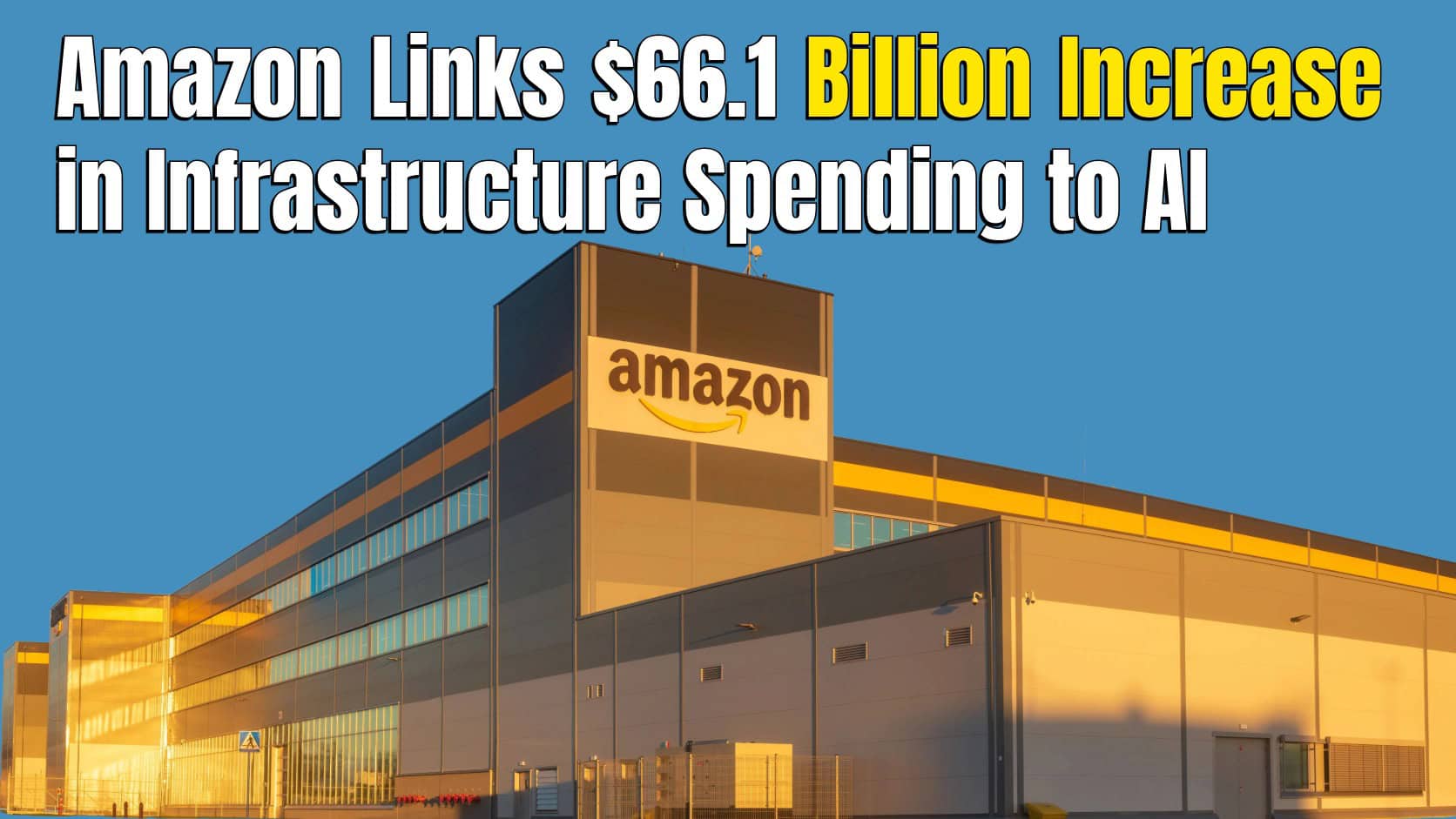
Amazon said a $66.1 billion year-over-year increase in purchases of property and equipment, net of sales and incentives, primarily reflects investments in artificial intelligence. The company also described Trainium commitments from Anthropic and OpenAI as multi-year and multi-gigawatt.
Together, the disclosures provide a material signal for future computing and power demand across Amazon Web Services. They do not, however, identify individual data-center campuses, power-generation facilities, project locations, construction schedules or project-specific capital budgets.
The $66.1 billion is the increase in Amazon’s trailing-12-month property and equipment investment compared with the prior period. It is not a disclosed AWS capital budget, the cost of a single AI program or a forecast of future construction spending.
How Much AI-Related Infrastructure Investment Did Amazon Report?
Amazon reported that purchases of property and equipment, net of sales and incentives, increased $66.1 billion year over year during the trailing 12 months ended June 30, 2026. The company said the increase primarily reflects investments in artificial intelligence.
That wording establishes AI as the principal driver of the increase, but it does not establish that the entire $66.1 billion was spent on AI infrastructure. Amazon’s property and equipment activity also covers a wider business that includes data centers, fulfillment infrastructure, transportation equipment, offices and other assets.
The release provides historical spending information rather than a forward capital budget. It does not divide the increase among AWS regions, data-center buildings, computing equipment, power infrastructure, cooling systems or network expansion.
| Amazon infrastructure signal | Company-reported detail | What the disclosure establishes |
|---|---|---|
| Increase in property and equipment purchases, net of sales and incentives | $66.1 billion year over year | Amazon says the increase primarily reflects AI investment |
| Trainium customer demand | Multi-year, multi-gigawatt commitments | Anthropic and OpenAI are committing to large-scale AWS AI computing capacity |
| Global data-center water efficiency | More than 7 times the industry average | Amazon reports an operational efficiency measure across its global data centers |
| Water-positive goal | 75% progress toward a 2030 global data-center goal | Amazon reports progress at the portfolio level rather than at a named project |
Anthropic and OpenAI Make Multi-Gigawatt Trainium Commitments
Amazon said Anthropic and OpenAI have made multi-year, multi-gigawatt commitments associated with AWS Trainium. Trainium is Amazon’s purpose-built machine-learning chip platform for training and deploying AI models.
The disclosure is commercially significant because gigawatt-scale computing commitments require more than processors. Deployment at that scale could involve data-center buildings, substations, transmission and interconnection capacity, backup and primary power systems, cooling equipment, water infrastructure, networking and large quantities of electrical equipment.
Amazon did not state whether the multi-gigawatt description applies separately to each customer or to the commitments collectively. The release also does not provide:
- The number of data-center campuses involved
- The locations or AWS regions receiving the capacity
- A megawatt or gigawatt allocation by customer
- The type or ownership of associated power generation
- Construction or operating schedules
- EPC firms, equipment suppliers or technology contractors
The commitments should therefore be treated as evidence of demand at scale—not as proof that a particular physical project has been sanctioned or awarded.
Amazon’s Global Data Centers Report Water-Efficiency Progress
Amazon also said its global data centers are more than seven times as water-efficient as the industry average. The company reported reaching 75% progress toward its goal of becoming water positive across global data-center operations by 2030.
Those figures provide insight into Amazon’s data-center operating priorities. Continued expansion could create demand for water-management systems, advanced cooling, controls, heat-rejection equipment, treatment systems and water-reuse infrastructure.
What Could the AI Investment Signal Mean for Industrial Suppliers?
Amazon’s disclosure supports a broad conclusion: the physical infrastructure required for AWS AI workloads is continuing to expand. If the reported customer commitments translate into additional capacity, they could support demand across:
- Data-center civil work, foundations and structural systems
- Utility interconnections, substations, switchgear and transformers
- Primary, backup and onsite power-generation equipment
- High-voltage transmission and electrical construction
- Liquid cooling, chillers, heat rejection and water treatment
- Networking, fiber and high-density computing infrastructure
- Building controls, automation and energy-management systems
- Commissioning, testing, operations and maintenance services
These categories are an Allstream assessment of infrastructure commonly associated with gigawatt-scale AI computing. Amazon has not announced solicitations, bid packages, vendor selections or construction awards for those scopes in the second-quarter release.
Allstream Perspective
Amazon’s second-quarter release is most useful as evidence of the scale behind AI infrastructure demand. A $66.1 billion year-over-year increase in property and equipment investment, described as primarily AI-driven, shows that the physical buildout extends well beyond software development.
The Trainium commitments add a second important signal. Amazon is describing demand from Anthropic and OpenAI in gigawatts and years, which places the infrastructure requirement in the same planning framework used for major data-center campuses and power systems.
What the release does not provide is equally important. There are no project names, locations, power sources, construction schedules or project-specific budgets. Contractors and suppliers should use the disclosure as market context while looking to permits, utility filings, local development agreements and project-level Amazon announcements for actionable construction intelligence.