
Two new air separation units will support two semiconductor fabrication facilities in Arizona as Linde targets $5.5 billion to $6 billion of companywide capital spending in 2026.
Published by Allstream Insiders
Allstream Insiders Summary
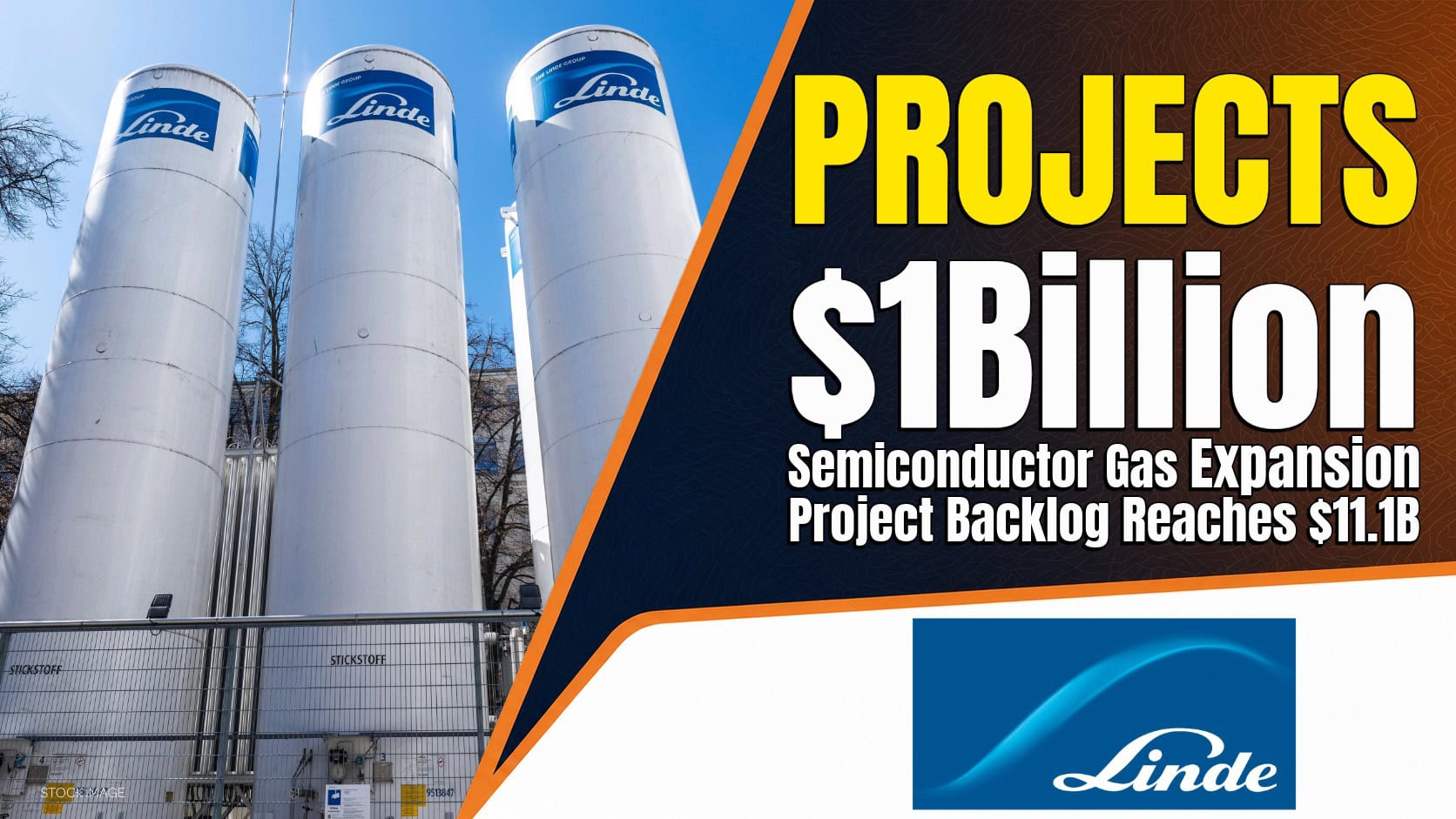
Linde plans to invest $1 billion to expand its on-site industrial-gas complex in Phoenix, Arizona, under a long-term supply agreement with an unnamed semiconductor manufacturer. The company will build, own and operate two new SPECTRA air separation units and associated infrastructure to supply ultra-high-purity nitrogen, oxygen and argon to two new semiconductor fabrication facilities.
The Phoenix project was the largest named U.S. investment accompanying Linde’s second-quarter 2026 update. Linde said the U.S. electronics contract increased its sale-of-gas project backlog by approximately $1 billion, bringing that backlog to $8.1 billion at June 30. The company’s presentation reported a total project backlog of $11.1 billion, consisting of the $8.1 billion sale-of-gas backlog and a separate $3.0 billion third-party sale-of-plant backlog held by Linde Engineering.
Linde currently expects companywide 2026 capital expenditures of $5.5 billion to $6.0 billion for growth and maintenance requirements. During the second quarter, it spent $1.438 billion, including $780 million of project capital and $658 million of base capital. Capital expenditures for the first six months of 2026 totaled $2.780 billion.
Management also said Linde expected to start up more than 20 projects representing approximately $1.3 billion of investment during the remainder of 2026. The company did not publish a project-by-project list for those anticipated startups, so they should not be treated as exclusively U.S. projects.
Linde Project and Capital Tracker
| Project or capital category | Confirmed scope | Disclosed value | Reported status or schedule |
|---|---|---|---|
| Phoenix semiconductor gas expansion – Arizona | Two new SPECTRA air separation units and associated infrastructure supplying ultra-high-purity nitrogen, oxygen and argon to two new semiconductor fabrication facilities | $1 billion | Linde said plant construction had begun under reimbursable letters of intent while final supply contracts were completed; no startup date was announced |
| Sale-of-gas project backlog | Linde-owned project investments supported by long-term customer supply agreements | $8.1 billion | Represents the estimated capital cost of large plants under construction at June 30, 2026 |
| Linde Engineering sale-of-plant backlog | Future third-party plant sales secured under signed agreements, primarily involving engineering and procurement services | $3.0 billion | Backlog reported at June 30, 2026 |
| Total project backlog | Sale-of-gas plus sale-of-plant backlog | $11.1 billion | Presentation figure; the earnings release rounded the amount to $11 billion |
| 2026 capital-spending outlook | Companywide growth and maintenance expenditures | $5.5 billion to $6.0 billion | Full-year company expectation as of July 31, 2026 |
| Remaining 2026 project startups | More than 20 projects across Linde’s global portfolio | Approximately $1.3 billion of investment | Management expected the projects to start during the remainder of 2026 |
| Blue Point One air separation unit – Louisiana | Linde-owned world-scale air separation unit supplying oxygen and nitrogen to the Blue Point One ammonia plant | More than $400 million | Separately announced project with startup currently targeted for 2029 |
| Mims industrial-gas expansion – Florida | Additional liquid-oxygen and nitrogen capacity supporting nearby space-launch operations | Not announced | Separately announced expansion currently targeted to start in the first quarter of 2027 |
What Is Linde Building in Phoenix?
Linde will add two air separation units to an existing Phoenix industrial-gas complex that already contains three units. The expansion will increase the site’s supply of ultra-high-purity nitrogen, oxygen and argon for two new advanced semiconductor fabrication facilities.
Linde identified the customer only as one of the world’s largest semiconductor manufacturers. The company did not name the two fabrication facilities, and Allstream is not assigning the project to a specific chipmaker or fabrication program.
During Linde’s earnings call, management said construction of the new plants had already begun under reimbursable letters of intent while the long-term supply contracts were being finalized. Linde did not provide a construction-completion or commercial-startup date in the project announcement.
The Phoenix investment will complement Linde’s existing Arizona production network. Under the disclosed commercial structure, Linde will build, own and operate the new gas-production units rather than transferring ownership of the facilities to the semiconductor customer.
Linde LienHwa, Linde’s joint venture partner in Taiwan, was selected by the same unnamed customer for separate projects involving air separation and hydrogen-production units. The joint venture plans to invest approximately $800 million in Taiwan. Management expressly said those Taiwan joint-venture wins were not included in Linde’s $8.1 billion sale-of-gas backlog.
What Does Linde’s $11.1 Billion Project Backlog Represent?
The $11.1 billion total combines two different types of contracted work and should not be interpreted as Linde’s 2026 capital budget. Linde reports the components separately:
- $8.1 billion sale-of-gas backlog: Linde investments in plants supported by long-term customer supply agreements. The company’s Form 10-Q describes the amount as the total estimated capital cost of large plants under construction.
- $3.0 billion sale-of-plant backlog: Future third-party plant sales secured under signed agreements through Linde Engineering, primarily covering engineering and procurement services.
Linde’s presentation indicated that approximately 75% of the sale-of-gas backlog was in the Americas, with 20% in Asia Pacific and 5% in Europe, the Middle East and Africa. “Americas” is a regional reporting category and should not be read as entirely U.S. investment.
By end market, Linde presented the sale-of-gas backlog as approximately 56% chemicals, 22% electronics, 14% manufacturing, 7% metals and mining, and 1% energy. The company also classified 57% of the portfolio under its clean-energy grouping. Those percentages describe the composition of the sale-of-gas backlog, not separate amounts that should be added to the $8.1 billion total.
How Much Is Linde Planning to Spend in 2026?
Linde expects full-year 2026 capital expenditures of $5.5 billion to $6.0 billion for growth and maintenance requirements. This companywide range includes spending required to advance the contracted sale-of-gas backlog, but Linde did not allocate the entire range by project, country or facility.
The second-quarter presentation divides capital spending into two categories:
- Project capital: Investments exceeding $5 million that provide incremental growth and are supported by long-term customer supply agreements.
- Base capital: Maintenance, smaller growth projects and other non-project investments.
Linde reported $780 million of project capital and $658 million of base capital during the second quarter. Its Form 10-Q said first-half capital spending increased primarily because of investments in new plants and production equipment required for backlog growth.
The annual capital outlook and the $11.1 billion project backlog measure different things. The annual range is expected spending during 2026; the backlog represents contracted projects that may be executed over multiple years.
Which Projects Could Start During the Rest of 2026?
Linde said it expected more than 20 projects representing approximately $1.3 billion of investment to start up during the remainder of 2026. Management did not publish the project names, individual values or locations in the earnings materials.
The anticipated startups therefore provide a portfolio-level schedule indicator, not confirmation that 20 new U.S. facilities will enter service. Linde said it expected its sale-of-gas backlog to remain above $8 billion after accounting for those startups, based on the project opportunities management was evaluating at the time of the call.
For project tracking, a startup moves an investment from construction into commercial operation. It should not be counted as a new award unless Linde separately announces a new contract or backlog addition.
Which Other U.S. Linde Projects Are Publicly Identified?
Linde has separately announced industrial-gas investments supporting Louisiana ammonia production and U.S. commercial space activity. These projects provide additional visibility into the types of U.S. facilities under development, although Linde has not published a project-by-project reconciliation of its $8.1 billion sale-of-gas backlog.
In Ascension Parish, Louisiana, Linde plans to invest more than $400 million to build, own and operate a world-scale air separation unit for the Blue Point One low-carbon ammonia complex. The plant is expected to supply oxygen and nitrogen and currently carries a 2029 startup target.
At Mims, Florida, Linde is expanding an existing industrial-gas facility to add liquid-oxygen and nitrogen capacity for nearby space-launch operations. The additional capacity is currently expected to start during the first quarter of 2027.
Linde’s second-quarter call also indicated that the company anticipated additional base-capital investments to support commercial space customers. Management did not provide project names, values or locations for that prospective spending, so Allstream is not treating it as an awarded construction program.
What Could the Phoenix Project Mean for the Industrial Supply Chain?
The confirmed Phoenix scope consists of two new air separation units and associated infrastructure, with Linde serving as owner and operator. Based only on that disclosed configuration—not on announced bid packages—the work could involve:
- Air-separation process equipment, cold boxes and purification systems
- Compressors, pumps, heat exchangers and cryogenic equipment
- Ultra-high-purity gas piping, filtration, monitoring and delivery systems
- Civil works, foundations, structural steel and equipment setting
- Electrical systems, instrumentation, controls and backup-power integration
- Bulk storage, vaporizers and interconnections with the existing three-unit complex
- Testing, commissioning and semiconductor-grade purity validation
Linde has not identified outside engineering, construction or equipment contractors for the Phoenix expansion. These categories are conditional Allstream analysis derived from the announced facility configuration; they are not confirmed solicitations, awards or guarantees of outside work.
Allstream Perspective
Linde’s second-quarter update provides one major named U.S. project and a much larger contracted portfolio that remains only partly itemized. The $1 billion Phoenix expansion is the clearest near-term project signal because Linde identified the location, investment, ownership structure and principal equipment scope and said construction had begun.
The $11.1 billion backlog provides broader capital visibility, but it should not be presented as a one-year budget, entirely U.S. spending or a list of open contracting opportunities. For contractors and suppliers, the next useful indicators will be a Phoenix startup schedule, facility-specific execution awards, the identities of Linde’s remaining 2026 startups and additional details on the company’s planned commercial-space investments.