
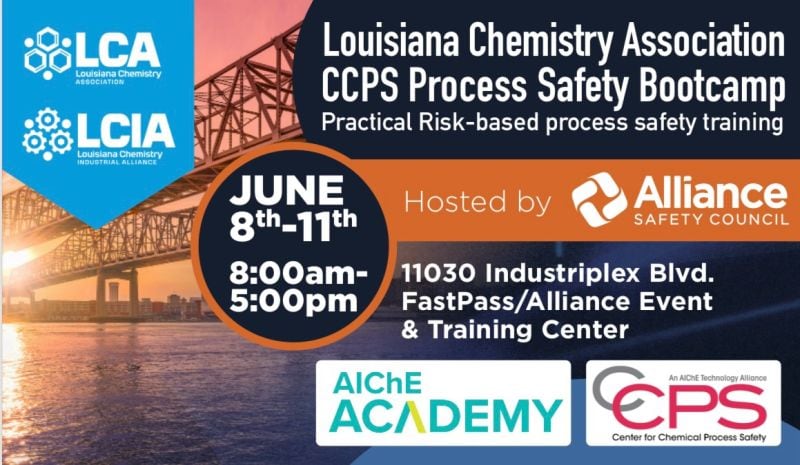
Register Now for the Louisiana Chemistry Association (LCIA) CCPS Process Safety Boot Camp – June 8 – June 11, 2026 – Baton Rouge, LA
CCPS Process Safety Boot Camp Comes to Louisiana
In partnership with the Louisiana Chemistry Association and hosted by the Alliance Safety Council of Baton Rouge, the
Center for Chemical Process Safety (CCPS) Process Safety Boot Camp is coming to Louisiana.
Process safety concepts are only part of the challenge — applying them effectively in real-world operations is what truly matters.
This intensive boot camp is designed to deliver practical, experience-driven training that participants can immediately apply at their facilities.
Whether you are new to process safety or an experienced professional looking to strengthen your approach, this program provides
valuable tools, updated best practices, and industry-leading guidance to help improve operational performance and reduce process safety events.
This training is designed to support safer facilities, stronger teams, and a more resilient industry across Louisiana and beyond.
If process safety is part of your role, this is a program you do not want to miss.
Register today and secure your spot.
About the Process Safety Boot Camp
The CCPS Process Safety Boot Camp is a high-impact, instructor-led introduction to the principles and practices of
Risk-Based Process Safety® (RBPS). Designed for professionals across operations, engineering, technical, and leadership roles,
this program provides the foundational knowledge needed to apply process safety directly to daily responsibilities.
The updated curriculum includes more than 30 newly integrated CCPS resources, making this one of the most current and comprehensive RBPS training programs available today.
Through modern adult-learning techniques, scenario-based exercises, interactive discussions, and practical case studies, participants will gain skills they can immediately implement in the field.
What Participants Will Gain
- Practical Understanding of RBPS
Learn how the 20 elements of Risk-Based Process Safety apply to real operational environments and day-to-day responsibilities. - Real-World Learning Outcomes
Engage in exercises, discussions, and case studies designed to strengthen hazard recognition, risk analysis, and operational decision-making. - Modernized Industry Guidance
Train using the latest CCPS terminology, methodologies, and best practices used throughout global manufacturing and industrial operations.
Why This Training Matters
Process safety is more than regulatory compliance — it is a discipline that protects people, facilities, communities, and businesses.
This boot camp equips participants with the vocabulary, frameworks, and methodologies needed to actively contribute to safer operations and stronger process safety performance throughout their careers.
Participants will leave with a clearer understanding of:
- How process safety incidents occur
- How operational risks are identified and managed
- How to apply RBPS principles within their own responsibilities
- How organizations can continuously improve process safety performance
Successful completion awards 3.2 CEUs and 32 PDHs.
Course Outcomes
By the end of the Process Safety Boot Camp, participants will be able to:
- Define and implement a process safety management system
- Apply the 20 elements of Risk-Based Process Safety to their role
- Understand process hazards and risk analysis methodologies
- Understand the fundamentals of risk management
- Evaluate lessons learned from real-world case studies
- Apply concepts to reduce process safety incidents and operational risk
- Improve process safety performance within their area of responsibility
Who Should Attend
This program is designed for industrial professionals whose responsibilities intersect with process safety, including:
- Engineers from all disciplines
- Chemists, technicians, inspectors, analysts, and specialists
- Operators, mechanics, and hourly personnel
- Planning, procurement, and scheduling professionals
- Safety, health, and environmental personnel
- Frontline supervisors and operational leaders
- Unit managers and site leadership teams
Course Topics
The curriculum follows a structured, RBPS-aligned progression that moves from process safety fundamentals through hazard analysis, risk management, and continuous improvement.
- Introduction to Risk-Based Process Safety
- Process safety management systems and governance
- Leadership, culture, and workforce involvement
- Process hazards and process safety information
- Hazard identification and risk analysis (HIRA)
- Process hazard analysis methodologies
- Preventive and mitigative safeguards
- Management of change and organizational change
- Asset integrity and reliability
- Human factors and conduct of operations
- Training, contractor management, and alarm management
- Incident investigation and continuous improvement
- Process safety culture and operational excellence
- Capstone project and applied learning exercises
Training Schedule Overview
Day One
- Registration & Welcome
- Introduction to Process Safety
- Loss of Containment & Incident Prevention
- Commit to Process Safety Foundation Block
- Process Safety Culture & Compliance
Day Two
- Human Factors & Process Safety Knowledge Management
- Chemical Hazards & Inherent Safety
- Plant Design Considerations
- Hazard Identification & Risk Analysis
Day Three
- Risk Assessment & Risk Tolerance
- Operating Procedures & Safe Work Practices
- Asset Integrity & Contractor Management
- Training & Performance Assurance
Day Four
- Management of Change
- Operational Readiness & Emergency Management
- Incident Investigation & Auditing
- Metrics, Reviews & Continuous Improvement
- Capstone Project
Important Information
Please Note: Participants attending the in-person training are required to bring a laptop.
Electronic course materials will be distributed prior to the start of the course.
Join industry professionals from across operations, engineering, manufacturing, and safety disciplines for an immersive learning experience focused on building safer facilities and stronger process safety cultures.

Recent Comments