This article is brought to you by: Turner Industries, leaders in SIPA, Scaffolding, Insulation, Painting, & Abatement

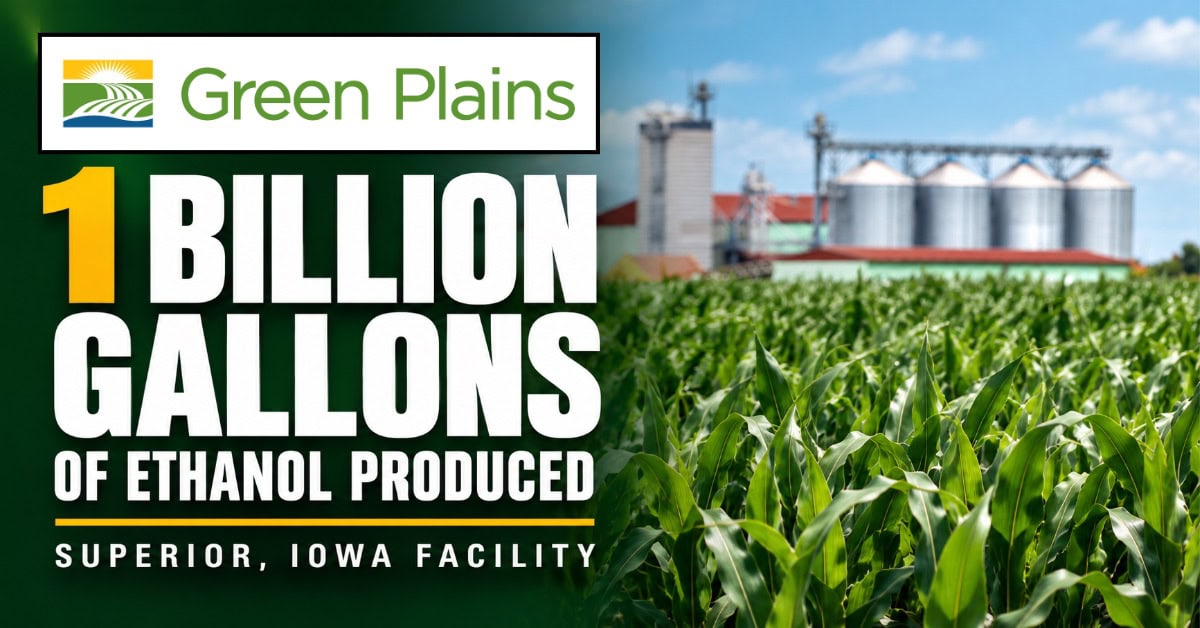
Green Plains says its Superior, Iowa, ethanol facility has produced one billion gallons since starting operations in 2008, marking a long-term operating milestone rather than a new capacity-expansion announcement.
Published by Allstream Insiders
Allstream Insiders Summary
Green Plains Inc. reports that its ethanol facility in Superior, Iowa, has produced its one-billionth gallon of ethanol. According to the company’s October 1, 2026, announcement, the facility was commissioned in 2008 and was among the first production assets in the Green Plains fleet.
The one-billion-gallon figure is a cumulative production milestone over the facility’s operating life. It is not a statement of current annual capacity, current throughput or an incremental production expansion.
Green Plains said the facility employs nearly 50 team members and supports local farmers, grain haulers, contractors and agribusiness partners across Northwest Iowa and Southwest Minnesota. The announcement does not disclose a plant-expansion project, current nameplate capacity, capital budget, equipment upgrade, construction scope or contractor award.
Superior Facility Milestone at a Glance
| Item | Company-reported detail |
|---|---|
| Facility | Green Plains ethanol facility in Superior, Iowa |
| Reported milestone | One billion gallons of cumulative ethanol production |
| Commissioning year | 2008 |
| Workforce | Nearly 50 team members |
| Regional network cited by Green Plains | Farmers, grain haulers, contractors and agribusiness partners in Northwest Iowa and Southwest Minnesota |
| New expansion project | Not disclosed in the announcement |
| Current capacity or annual output | Not disclosed in the announcement |
What does one billion gallons represent?
The reported milestone represents total ethanol produced at the Superior facility since it began operating in 2008. Green Plains did not state the date on which the one-billionth gallon was produced, nor did it publish annual production, current operating rate or plant capacity in the October announcement.
That distinction matters: cumulative production reflects the facility’s historical operating record, while annual capacity and current throughput would measure different aspects of its present operations. The release does not provide those additional figures.
How does the facility connect with the regional agricultural supply chain?
Green Plains describes the Superior facility as supporting a regional network of farmers, grain haulers, contractors and agribusiness partners. The facility was originally developed by Superior Ethanol LLC to create a market for regional grain producers, according to the announcement.
Green Plains did not identify individual suppliers, transport providers, contracts or purchasing programs in the release. The cited regional relationships provide operating context, not evidence of newly announced supplier work or procurement opportunities.
What has not been announced?
The October 1 announcement is an operating-history milestone, not a capital-project announcement. Green Plains did not disclose a new ethanol-production expansion, maintenance turnaround, carbon-intensity upgrade, technology installation, capital authorization, construction schedule or contractor selection for the Superior facility.
The company also did not announce a change to the facility’s current production capacity or provide a future production target. Those items should not be inferred from the cumulative one-billion-gallon figure.
Allstream perspective: a long-term operating marker for a regional biofuels asset
The Superior milestone shows the long operating history of a biofuels production asset commissioned in 2008. For regional agricultural and industrial participants, the company’s announcement connects the facility to grain sourcing, transportation and local service networks, but it does not establish a new construction or procurement event.
Future decision-useful disclosures would include a capacity change, equipment upgrade, carbon-intensity project, maintenance scope, capital authorization or a supplier and contractor award. Until such details are announced, the one-billion-gallon milestone should be treated as a cumulative production achievement rather than a new plant-development opportunity.